Council’s popular food and garden waste service makes it easy for residents to turn everyday food scraps and garden clippings into valuable compost.
To help reduce the amount of waste sent to landfill, all households that do not currently have a food and garden waste bin service will receive a new food and garden waste (green lid) bin in June 2026.
What this means for you
- If you don’t have a food and garden waste bin, one will be delivered to you between 1 June and 26 June 2026, along with a kitchen caddy and a roll of compostable caddy liners to get you started.
- Your food and garden waste bin will be collected every two weeks starting on Monday 6 July 2026. See Check my bin collection day for your collection schedule.
- Your rubbish bin will still be collected weekly.
- If you already have a food and garden waste bin, nothing is changing. It will still be collected as usual.
- The food and garden waste service is now part of the standard kerbside collection service. All households will receive this service, and you no longer need to opt in or out.
More information will be sent by mail to households receiving the new bin in April and May 2026.
Why is every household receiving a food and garden waste bin
Almost half of household waste is made up of food. Using your food and garden waste bin keeps this waste out of landfill, cuts emissions, and turns it into compost.
This compost is used in the parks, schools, community spaces, gardens and farms in Victoria.
As part of the Victorian Government’s kerbside reform, all councils are required to introduce a standard four-bin system across the state.
Food and garden waste bin collections
Food and garden waste is collected every two weeks (fortnightly), on the opposite fortnight to your recycling bin collection, and on the same day as your rubbish bin.
Find out your rubbish collection day by entering your address.
Public holiday bin collections
Your bins will be collected as normal on public holidays that fall on business days, except for the following public holidays:
- New Year's Day
- Good Friday
- ANZAC Day
- Christmas Day
If any of these public holidays fall on your usual collection day, we'll pick up your bins a day later. Collections may run one day behind schedule for the rest of that week.
Important food and garden waste bin guidelines
Follow these steps to make sure your bin gets collected:
- All items from the garden must be placed loosely in the bin.
- Don't put anything in the bin that stops you from being able to close the lid.
- Place grass clippings near the top of the bin so it's easier to empty.
- Cut branches and prunings up so they easily fit into the bin.
- Branches must be less than 30 cm in diameter.
- No tree stumps will be accepted.
- Food waste can be put in the bin loosely or in an approved caddy liner.
- If using caddy liners, make sure they are lime green compostable liners that are Australian Commercial Composting Standard certified.
- Place your bins at least half a metre apart on your nature strip for collection.
Food and garden waste bin fees
From the 1 July 2026, the food and garden waste bin is covered through the annual waste service charge on owner annual rates notices.
This fee will appear on rates notices and covers a full year (1 July to 30 June) of service including collection and processing for all waste collection service. This includes your rubbish, recycling, glass recycling and food and garden waste and other waste services like hard rubbish collections and waste disposal vouchers.
What you get
You will receive:
- a 240 litre food and garden waste bin with a light green lid
- a 7 litre kitchen caddy for collecting food waste in your home
- one roll of 150 compostable liners.
Cancel your food and garden waste bin
You cannot cancel your food and garden waste bin service.
Industrial and commercial properties
Please note only residential properties can have a food and garden waste bin. Industrial or commercial properties are not eligible.
It's important that the right items are placed into your food and garden waste bin.
If the wrong items go in, they can't be composted at the composting facility.
Please note which items you can and can't put in your bin and ensure that all members of your household are aware.
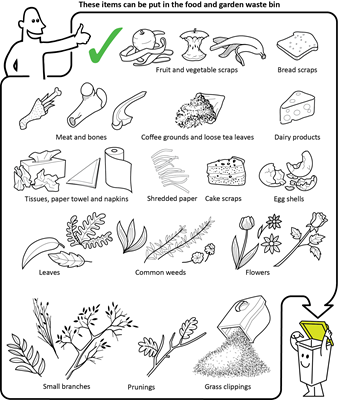
Acceptable items
You can put the following into your food and garden waste bin:
- bread and cake scraps
- common garden weeds
- dairy products
- egg shells
- flowers
- food scraps from meals
- food that has passed its use by date
- fruit and vegetables
- grass clippings
- leaves
- loose tea leaves and coffee grounds
- meat and seafood (raw and cooked, including bones)
- prunings
- small branches
Unacceptable items
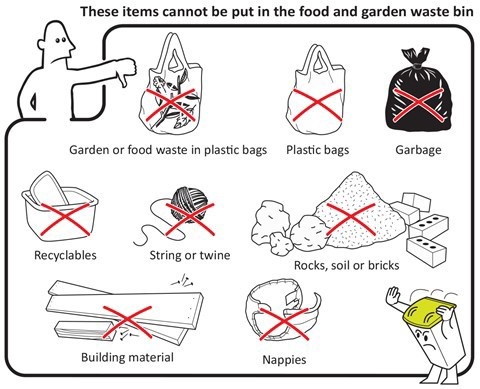
Please don't put the following items into your food and garden waste bin because they can't be composted at the composting facility:
- Any cady liners that are not lime green or marked AS 4736
- Batteries and e-waste
- building material, concrete, soil, rocks and bricks
- cigarette butts
- vapes and e-cigarettes
- cardboard boxes or pizza boxes
- coffee pods or takeaway coffee cups
- dog or cat droppings
- food and garden waste in plastic bags
- glass
- hair (including pet hair)
- household garbage
- kitty litter
- nappies or baby wipes (including compostable or biodegradable nappies)
- paper plates and coffee cups
- plant pots
- plastic bags and plastic packaging (including bags, cling wrap, ties)
- products labelled as compostable (like coffee cups, plates and takeaway containers)
- rubbish or recyclable items
- scrap metal
- sharps, medicines, batteries and toys
- tea bags
- tree stumps and ash
- vacuum dust
- wooden icy pole sticks.
When you receive your new food and garden waste bin, you will receive one free roll of 150 compostable caddy liners to help collect food waste in your home.
Using these liners makes handling your food waste easier, meaning you can help the environment with less clean-up.
Residents can collect their free annual roll of 150 compostable liners from:
- Civic Centre, 25 Ferres Boulevard, South Morang – Weekdays, 8:30am to 5:00pm
- Whittlesea Service Hub, 63 Church Street, Whittlesea – Weekdays, 9:30am to 5:00pm
Proof of residence is required upon collection.
If you are unable to collect in person, please contact us on 03 9217 2170.
Purchase additional caddy liners
If you want to purchase additional caddy liners, they are available from most major supermarkets.
- Please make sure that the liners are 100% compostable Australian certified bags. They'll be lime green in colour.
- Your kitchen caddy is 7 litres, so choose a 7 or 8 litre capacity liner.
You don't have to use caddy liners. You can simply place food scraps directly into the food and garden waste bin and give it a wash after each use. Alternatively, you can use newspaper to line the kitchen caddy to reduce mess in the bins.
Tips on opening caddy liners
The bin liner bags we provide to use in your kitchen caddy can sometimes be a little tricky to open.
They're fragile because they're made from corn starch and designed to break down easily. They may not seem to open all the way or they may appear have split down the middle.
If you place the bag in front of you with the arrows up, and then rub the top of the bags between your thumb and forefinger, the sides will separate into a full bag. It’s a little similar to what you would do to the plastic fruit bags at the supermarket.
Below is a handy video that may also help you with your bags.
What are the benefits of a food and garden waste collection service?
There are many benefits to a Food Organics Garden Organics (FOGO) collection system, including:
- reducing the amount of food waste that ends up in landfill, saving landfill space and reducing greenhouse gas emissions
- saving money on rising landfill costs
- producing a quality compost product for use in gardens, parks, farms and open spaces.
Why can't I include soil in my food and garden waste bin?
Soil and turf are too heavy for the bins. The weight of soil or turf can cause damage to the truck lift or cause the bin itself to crack or break.
If you need to dispose of soil that can't be re-incorporated into your garden, you can take it to Heidelberg Materials (Wollert landfill) (charges apply).
How often will my food and garden waste bin be collected?
Your food and garden waste bin will be emptied fortnightly. Please see our bin collection schedule for more information.
I'm a tenant. Do I receive a food and garden waste bin?
Yes, if you're a tenant in a rental property, you will receive a food and garden waste bin.
What do I do if my kitchen caddy breaks?
Council supplies one kitchen caddy per household. We’re unable to supply replacements.
If your caddy breaks, you can use other containers, such as an old ice cream container, to store your food scraps before placing them in the food and garden waste bin.
Alternatively, you can purchase a kitchen caddy from a retail store such as Bunnings or Kmart.
Do I have to use caddy liners?
No, you don’t need to use the caddy liners if you don’t want to. You can line your caddy with newspaper or paper towel or simply place the food waste loose into the bin, as shown in the video below.
How do I avoid bin smells?
Here are our top tips for avoiding smells in your food and garden waste bin:
- Keep your food and garden waste bin in the shade.
- Don’t overfill your bin, and make sure you keep the lid closed.
- Before you place your compostable caddy in your bin, tie the caddy bag in a knot at the top so food can’t spill out into the bin.
- If you prefer not to use compostable caddies, wrap your food waste in paper towel or newspaper before you put it in the bin.
- Keep seafood and meat scraps in the freezer until the night before your collection day.
- Wash your caddy regularly using detergent or eucalyptus oil or by placing it in the dishwasher.
- Sprinkle some bicarbonate of soda (baking soda) in your caddy and bin to absorb any smells.
- Layer food waste between lawn clippings or garden waste.
How do I avoid maggots in my food and garden waste bin?
Meat, bones and other protein sources can attract flies and maggots.
Here are some tips to try to avoid maggots:
- Drain as much liquid as possible from your food scraps.
- Wrap meat scraps and bones in a sheet of newspaper before putting them in your bin.
- Freeze meat, fruit and vegetables in newspaper or paper bags and put them in your green bin the night before pick up.
- Alternate layers of kitchen waste with layers of paper product.
- Line the outer rim of your bin with salt or vinegar.
- Clean your food and garden waste bin regularly using warm water and mild soap. Wash and rinse your bin on your lawn, not near gutters or storm drains, because the rinse water might flow into local creeks and waterways.
- Keep the bottom of your green bin dry by lining it with newspaper or paper towel to absorb liquid and prevent material from sticking to it.
- Eliminate or minimise smells by sprinkling your bin with vinegar or baking soda.
- Store your green bin in a shady, well-ventilated area.
I’ve found maggots in my food and garden waste bin. How do I get rid of them?
Try covering the maggots with lime, salt or vinegar, and spraying the top and inside of your bin with vinegar.
I already compost my food scraps and garden waste at home. Can I just keep doing this?
If you already compost your food and garden waste at home, that’s great and we encourage you to continue.
But it’s important to note that the food and garden waste collection service allows you to recycle a larger variety of food waste and garden waste than you can compost at home.
It can also take organic material that doesn’t easily break down, or that needs to be chopped up into smaller pieces at home, such as meat, fish, bones, corn cobs, fruit stones and watermelon skins.
Where does the collected food and garden waste go?
The food and garden waste is transported to Repurpose It in Epping, where it’s made into compost using a highly controlled composting process. This process takes 8 - 10 weeks.
The compost is used as soil fertiliser in a wide range of settings, including farms, parks, schools and community gardens.