Parking information
The City of Whittlesea employs a dedicated team of parking officers to maintain safety, ensure fair access to parking, and respond to resident requests.
Our parking officers patrol streets, car parks, schools, and shopping areas to help:
- increase the safety of pedestrians and motorists
- create turnover and availability in parking areas
- and improve parking behaviour in our community.
Parking complaints
Parking complaints are allocated to the nearest parking officer, who will attend the location to investigate as soon as possible. For emergency issues outside of business hours, you should contact Victoria Police.
Parking officers are unable to issue infringements solely based on photos. They must attend the location and observe the offence.
To assist our investigations, please provide as much detail as possible, including:
- the vehicle registration details
- the colour and make of the vehicle
- the location and address
- the day/s of the week the vehicle is there
- the approximate time (for example, in the morning or evening, or all day)
- the offence you suspected is being committed.
Report a vehicle
You can report an illegally parked vehicle via:
Parking on a footpath, nature strip or dividing strip
Council is responsible for keeping footpaths, nature strips and dividing strips safe and accessible for everyone.
Parking on a footpath, nature strip or dividing strip is illegal. It is an offence to park in a driveway if the vehicle sticks out over the footpath.
We understand some people park on nature strips because it may free up parking spaces on the road – but these areas are designed for pedestrians and access to utilities, not for vehicles.
Parking on a nature strip, even partially, is against the law and can cause damage to:
- the surface of the nature strip
- trees and their roots
- kerbs and drainage channels
- house drain connections
- and other underground services.
Parking at a train station
Council cannot enforce parking rules or issue fines in car parks at train stations.
If you have a parking issue at a train station, please contact Metro Trains.
Metro Authorised Officers enforce rules in car parks at the following train stations:
- Mernda
- Hawkstowe
- Middle Gorge
- South Morang
- Epping
- Lalor
- Thomastown
- Keon Park
- Donnybrook
You may contact us to report illegally parked vehicles on roads outside train stations.
Parking in a loading zone
Loading zones may only be used by authorised vehicles, for a maximum of 30 minutes (unless signs specify otherwise). These vehicles must be:
- actively loading or unloading goods
- or picking up or dropping off passengers.
Authorised vehicles include trucks, vans, utilities, courier vehicles with permanent business signage, public buses, and commercial passenger vehicles such as taxis.
Parking around schools
Council is committed to helping maintain a safe environment around schools, including during pick-up and drop-off times.
For more information, visit our parking and safety around schools page.
Trucks in residential areas
Trucks parking in residential areas create significant safety, noise and amenity concerns. Large vehicles can obstruct visibility, restrict traffic flow, and increase the risk of accidents.
Under the Victorian Road Safety Rules 2017, it is an offence for any vehicle exceeding 7.5 metres in length or 4.5 tonnes Gross Vehicle Mass to be parked in a built-up area for more than one hour. There are no parking permits or exemptions that would allow a truck driver to exceed this one-hour parking restriction.
For more information, visit Transport Victoria.
Council actively monitors and enforces these requirements.
Key road rules and markings
Yellow lines
A solid yellow line on the edge of the road or kerb indicates you cannot stop or park there at any time, even briefly. These lines are typically found in high-traffic or narrow areas to improve safety.

White lines
You cannot park within 3 metres of a single or double solid white line (dividing line) on a road. This is to allow adequate room for other road users to safely pass by.
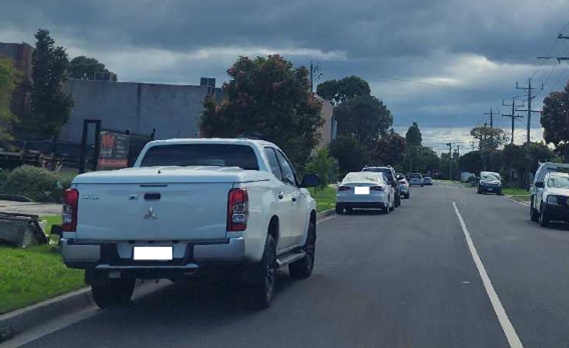
Parking near an intersection
In Victoria, you cannot park within 20 metres of an intersection with traffic lights, or within 10 metres of any other intersection, unless signs explicitly say you can park closer. This restriction is strictly enforced to ensure visibility.
Please note: It is not illegal to park opposite a T-intersection, as shown in the image below.
Parking near a fire hydrant
In Victoria, it is illegal to park or stop your vehicle within 1 metre of a fire hydrant, fire hydrant indicator, or fire plug indicator. This rule applies even if there are no signs or yellow lines.
Blocking a driveway
In Australia, it is illegal to block a driveway, including your own. You may briefly stop to drop off or pick up passengers, provided you stay with your vehicle and leave within two minutes.
It is also illegal to park across a public footpath, even if in a driveway.
It is not an offence to park opposite a driveway.
Wrong direction parking
In Victoria, it is illegal to park facing the wrong way. Vehicles must be parked parallel, on the left side of the road, facing the same direction as traffic.
Accessible (disability) parking permits
Accessible parking permits are available through the Victorian Government, not Council.
For more information, including how to apply, visit our accessible parking permit page.
Restricted parking areas
In Victoria, ‘overstaying’ means keeping your vehicle in a timed parking bay longer than permitted.
To avoid overstaying in a restricted parking area, follow these key rules:
- Read the signs: Signs with a number and the letter ‘P’ indicate the maximum hours you can park there. For example, ‘2P’ means a two-hour limit.
- Time limits: The time limit starts as soon as your vehicle stops in a space, not when you exit your vehicle.
- Day and time restrictions: Time limits only apply during the hours and days listed on the sign. Outside of those times, different rules may apply. If no hours are listed, the time limit always applies.
- Public holidays: Time limits apply on public holidays if signs do not have days marked on them.
- Moving spots: You cannot move your vehicle to another bay on the same street to reset your time. You must vacate the restricted parking area entirely.
- Monitoring methods: Inspectors use technology such as in-ground sensors, Licence Plate Recognition vehicles, and traditional tyre-chalking.
Common parking signs include:
- No parking: You cannot leave your car unattended. You may stop for a maximum of two minutes to drop off or pick up goods or passengers, and you must stay within 3 metres of your vehicle.
- No stopping: You cannot stop your vehicle here. Some signs display times. Outside of these times, standard parking rules apply.
- Taxi zone: Only licensed taxis in registered and clearly marked vehicles can stop here. Rideshare vehicles face heavy fines for using these zones.
- Bus zone: These areas are reserved exclusively for public buses. Stopping or parking a passenger vehicle in a bus zone is illegal.
- Mail zone: These areas are reserved exclusively for authorised postal vehicles, such as Australia Post vans, to collect or deliver mail. Other vehicles cannot stop here.
- Permit zone: These areas are reserved for vehicles displaying a valid permit (such as residents, visitors, or traders). These zones help manage congestion and prioritise parking for locals over commuters. Accessible parking permits are not valid in these zones.
Area parking
In Victorian shopping centres, signs indicate day and time restrictions. Whole streets may be managed by timed area restrictions.
How centres manage these areas:
- Time limits: Certain zones (such as those closest to supermarkets) are designated as short-term parking to ensure high turnover and convenient access.
- Permit zones: Specific areas are strictly reserved for accessible parking (disability permits), parents with prams, or staff parking.
The City of Whittlesea patrols the following private parking areas:
- BP Northpoint (1 Scanlon Drive, Epping)
- Costco (60 Deveney Road, Epping)
- DPV Health (20 Civic Drive, Mill Park)
- Gorman Drive (40 Bush Boulevard, Mill Park)
- Mernda Town Centre (180 Riverdale Boulevard, Mernda)
- Pacific Epping (571-583 High Street, Epping)
- Westfield Plenty Valley (415 McDonalds Road, Mill Park)
- Uni Hill Town Centre (5 Janefield Drive, Bundoora).
Parking motorcycles and scooters
Unless signs indicate otherwise, you can park your motorcycle or scooter on a footpath or nature strip in Victoria – however, you must not cause an obstruction.
Ensure you move carefully between the road and footpath, using the shortest route. Always give way to pedestrians.
When parking, you should position your motorbike or scooter at least:
- 1.5 metres (one bike length) from the building line, and
- 0.5 metre (one wheel diameter) from the kerb.
Your motorbike or scooter must not obstruct access to anything on or near a footpath, including:
- parking spaces
- kerb ramps
- taxi zones and bus stops
- doorways and entrances
- rubbish bins and post boxes
- fire hydrants
- service access points with covers in the footpath.